Automation and Robotics in 2026: What It Actually Means for the Factory Floor
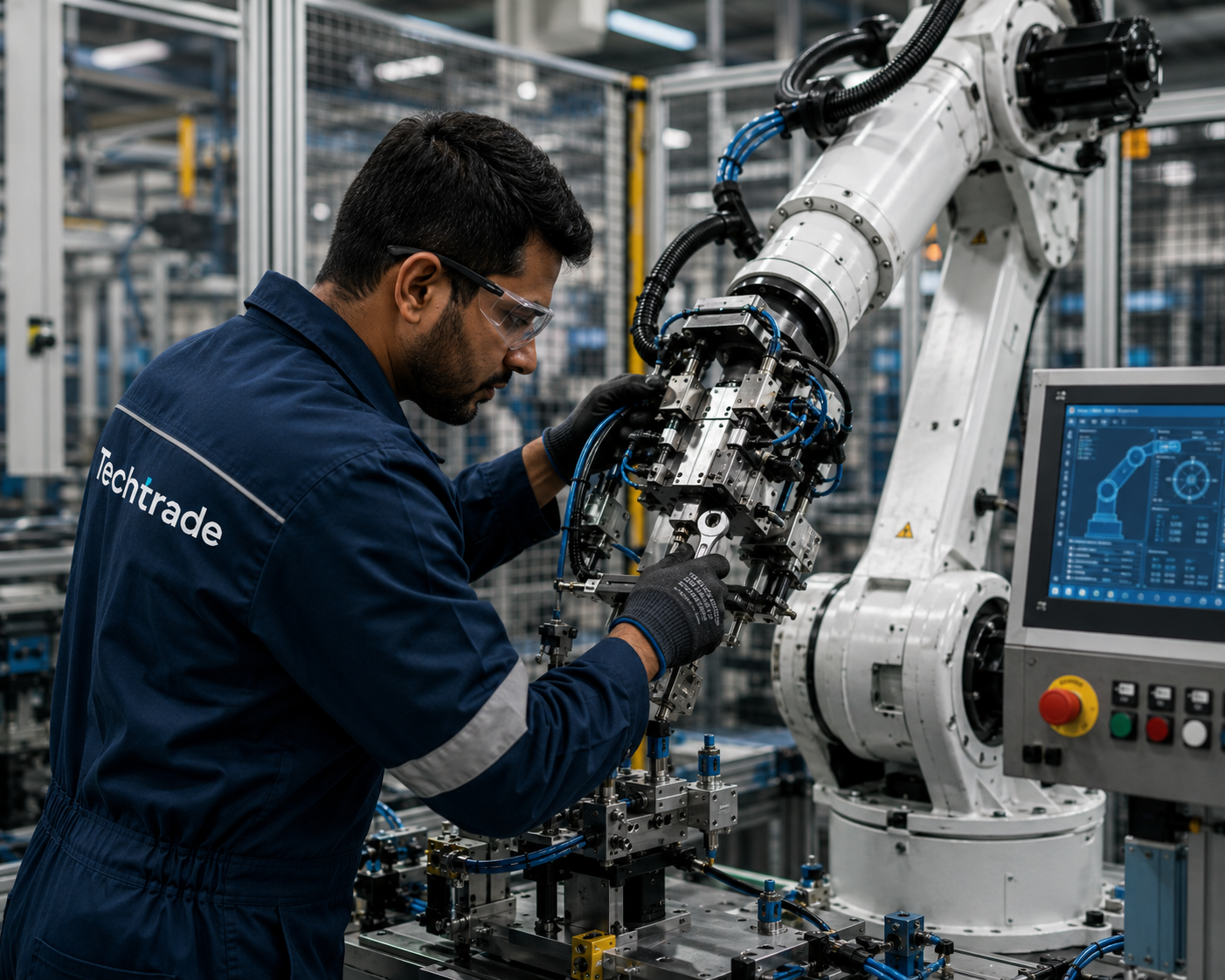
Automation has become difficult to discuss without the conversation quickly shifting to humanoid robots, artificial intelligence and predictions about fully automated workplaces.
For most New Zealand engineering and manufacturing businesses, that is not where the immediate value sits.
The useful applications are much more practical. Loading machines, moving materials, checking product quality, collecting equipment data, reducing repetitive manual handling and helping maintenance teams identify problems earlier.
The global investment behind this technology is significant. The latest International Federation of Robotics figures show that 542,000 industrial robots were installed during 2024, taking the number operating worldwide to approximately 4.66 million.
New Zealand is starting from a lower level of automation than many comparable manufacturing economies. Research published through Callaghan Innovation estimated that New Zealand had 55 robots per 10,000 manufacturing workers, compared with 371 in Germany and 934 in South Korea.
That gap does not mean every business should rush out and buy a robot. It does suggest there are still practical opportunities for New Zealand manufacturers, engineering workshops and industrial operators to improve productivity through well-planned automation.
This is particularly relevant as the manufacturing sector gains momentum. Manufacturing grew by 1.9 per cent in the March 2026 quarter and was the largest contributor to New Zealand’s quarterly economic growth.
Automation is being used to remove bottlenecks
Most businesses do not automate because the technology looks impressive.
They automate because a particular part of the operation is slowing production, creating quality issues, exposing people to avoidable risk or becoming increasingly difficult to staff.
Common starting points include:
- CNC machine loading and unloading
- Welding and repetitive fabrication
- Palletising and packaging
- Product sorting
- Materials handling
- Visual quality inspection
- Repetitive assembly
- Production and maintenance monitoring
These are generally structured, repeatable tasks where consistency matters.
The objective is not necessarily to remove a role. It is often to give skilled employees more time for fault-finding, problem-solving, setup, maintenance and work that requires experience and judgement.
A fitter who spends less time manually moving components can focus on keeping plant reliable. An operator who is no longer carrying out repetitive loading can monitor several processes, manage changeovers and respond to production issues.
That is where automation can support a workforce rather than simply reduce it.
Cobots are useful, but only when the job fits
Collaborative robots, commonly known as cobots, continue to attract attention because they can be more flexible than traditional industrial robot cells.
They can be useful for businesses with:
- Shorter production runs
- Regular product changeovers
- Limited factory space
- Repetitive processes
- High-mix, lower-volume production
- Tasks that need people and equipment to work closely together
Machine tending is a good example. A cobot may load raw material into a CNC machine, wait for the cycle to finish and remove the completed component. The machinist can then concentrate on programming, tooling, inspection and production planning.
Cobots can also be redeployed more easily than some fixed systems. That can make them attractive to smaller manufacturers that cannot dedicate a robot to one product for its entire working life.
However, the word “collaborative” does not automatically make an application safe.
The tool fitted to the robot, the component being carried, its operating speed and the surrounding machinery can all introduce risks. Every installation still requires proper design, risk assessment, controls, training and maintenance planning. WorkSafe notes that machinery remains a major source of workplace harm and that designers, manufacturers, importers and suppliers all have responsibilities for machinery safety.
Machine vision is making automation less rigid
Traditional automated systems perform best when every component arrives in exactly the same position and condition.
Real production environments are rarely that predictable.
Machine vision uses cameras, sensors and software to help automated equipment identify objects, check positioning, measure components and detect inconsistencies. This allows a system to respond to some of the normal variation found in manufacturing and engineering operations.
Practical applications include:
- Confirming that the correct component has been loaded
- Checking dimensions or surface condition
- Identifying missing parts
- Guiding a robot towards components that are not perfectly aligned
- Reading labels, barcodes or production markings
- Recording visual evidence for quality assurance
The result can be fewer manual checks, faster identification of defects and better production records.
Vision technology is also being explored for workplace safety. WorkSafe has supported New Zealand timber manufacturing trials involving AI-enabled systems that identify potential safety risks in real time.
The technology still needs clear operating rules and human oversight. Its value is in providing people with better information, not simply handing every decision to a machine.
The biggest gains may come from connected equipment
Robotic arms tend to receive the attention, but some of the most useful automation projects do not involve a robot at all.
They involve connecting machines, sensors, maintenance records and production systems so managers can see what is happening across the operation.
Industry 4.0 is largely about using data and digital technology to make better operational decisions. This can include machine monitoring, artificial intelligence, data analysis, connected sensors and automated reporting.
For an engineering or manufacturing business, better connectivity can provide clearer information about:
- Machine utilisation
- Unplanned downtime
- Cycle times
- Recurring faults
- Maintenance requirements
- Production bottlenecks
- Energy consumption
- Product quality
- Stock and materials movement
This information can help maintenance teams move away from reacting to breakdowns and towards planned or condition-based maintenance.
Digital twins take this further by creating a connected digital representation of an asset or system. MBIE identifies predictive maintenance, resource tracking and virtual testing as potential uses, although it also notes that data literacy and interoperability remain barriers to wider adoption in New Zealand.
A business does not need a complete digital twin programme to benefit from better data. Connecting one important production line or monitoring one recurring maintenance problem can be a sensible starting point.
Automation changes the skills a business needs
Installing new equipment does not remove the need for skilled people.
It changes the mix of skills required.
An automated production environment may need fewer hours spent on repetitive handling, but it can create greater demand for people who can:
- Install and commission equipment
- Programme PLCs, robots and control systems
- Diagnose electrical and mechanical faults
- Maintain sensors, motors, drives and safety systems
- Modify machinery for new products
- Analyse production data
- Manage continuous improvement projects
- Train operators
- Coordinate suppliers and system integrators
The people supporting automation commonly include:
- Automation engineers
- Controls engineers
- Industrial electricians
- Instrumentation technicians
- Mechanical and maintenance fitters
- Machine builders
- Commissioning engineers
- Mechatronics technicians
- Production engineers
- Reliability and maintenance planners
- Project managers
- Experienced operators and team leaders
Government manufacturing guidance recommends assessing existing workforce capability, identifying future skill gaps and helping employees develop the skills needed to work with robotics and automation.
This workforce planning needs to happen before equipment arrives.
A system may be installed by an external integrator, but the business will still need people who understand how to operate it, maintain it and resolve problems once the project team has left.
Maintenance should be part of the investment decision
A robot or automated production cell is still industrial equipment.
It will require inspections, servicing, spare parts, software support and people who can diagnose problems under production pressure.
Before approving an automation project, it is worth asking:
- Who will maintain the equipment after commissioning?
- Which faults can our current team resolve?
- What support is available from the supplier?
- Are critical spare parts available in New Zealand?
- What training will operators and maintenance staff receive?
- How will the equipment be safely isolated?
- Who will manage programming and software changes?
- What happens if the system becomes obsolete or unsupported?
The cost of ownership is broader than the purchase price.
A technically impressive system that regularly waits for offshore support may deliver less value than simpler equipment that the local maintenance team can keep running.
Start with the process, not the robot
The strongest automation projects usually begin with a clearly defined operational problem.
Before selecting technology, review the current process and ask:
Where is production regularly being held up?
Look for machines waiting for operators, excessive changeover time, manual handling delays or work that regularly builds up between production stages.
Which work is difficult to staff?
Repetitive shifts, physically demanding tasks and isolated processes can be sensible areas to assess.
Is the process stable?
Automating an inconsistent or poorly understood process can make the problem more expensive. Standardise the work before trying to automate it.
What result are we trying to achieve?
Set a measurable objective. This might be increased output, reduced downtime, fewer defects, safer handling or better use of skilled labour.
Do we have the people to support it?
Consider who will design, install, commission, operate, maintain and improve the system.
New Zealand businesses have historically invested less in plant, machinery and technology than other small advanced economies. MBIE has identified greater investment in automation, data analytics and productive equipment as an important part of lifting business productivity.
The objective, however, should not be automation for its own sake. It should be a reliable process that improves safety, quality, output or resilience.
Plan the workforce before commissioning starts
One of the most common risks in automation projects is leaving workforce planning until the equipment is almost ready to go live.
Installation and commissioning can create short-term demand for electrical, mechanical and technical contractors. Once production begins, the business may also need permanent maintenance, controls and production capability.
Planning early gives employers time to determine:
- Which skills already exist internally
- Which employees can be trained
- Which positions need to be recruited permanently
- Where temporary project support will be required
- Whether specialist contractors are needed for commissioning
- How maintenance coverage will work across different shifts
This is particularly important when several employers are competing for the same automation, electrical and maintenance skills.
Automation still depends on good people
The practical automation story in 2026 is not about replacing every person on the factory floor.
It is about using machines for the work they perform well, while making better use of the knowledge, judgement and technical capability of experienced people.
For employers, the question is no longer simply whether to automate.
It is where automation can provide a measurable improvement, how it will be supported and whether the business has the right people to make the investment work.
Techtrade supports engineering, manufacturing and industrial businesses with temporary, contract and permanent recruitment across electrical, automation, mechanical and skilled trade roles. We recruit automation engineers, industrial electricians, instrumentation technicians, mechanical fitters, machine builders, commissioning specialists, maintenance personnel, project managers and production leaders.
Our process starts with understanding your operation, the role, the site requirements and the technical capability you need. From there, we source and screen candidates through our networks, advertising and referrals, then complete the relevant qualification, reference, right-to-work and compliance checks. We also support onboarding, PPE, site inductions and ongoing post-placement care where required.
Whether you are preparing for a new installation, commissioning equipment, increasing maintenance coverage or building permanent in-house capability, Techtrade can help you find people who are suited to the work and ready to contribute.
The focus is not simply on filling a vacancy, but on providing reliable technical and trade talent that fits your operation, project timelines and longer-term workforce plans.

Ewen Morgan
An experienced sales and marine engineering professional known for his practical approach, industry knowledge and strong relationship-building skills.
Temporary, contract and permanent recruitment
Engineering | Trade | Manufacturing